Analysis · 7 min read · 484 views · November 12, 2026
New York AI Chatbot Law for Minors: What S9051-B Actually Does
Analysis: New York's S9051-B bans 12 unsafe AI companion features, from bots that claim to be human to flattery and long-term memory, for any user not verified as an adult. Here is what it says, who it affects, and the open questions before it starts January 1, 2027.
Written by The Ethics Lab Team. We are a student-run civic nonprofit that makes free AI literacy lessons for schools and speaks up for students in AI policy.
New York Governor Kathy Hochul signed S9051-B on October 28, 2026, a law that bars AI chatbot companies from offering minors a list of 12 "unsafe AI companion features," such as a bot that claims to be human or flatters a user to keep them talking. The New York AI chatbot law for minors becomes Article 48 of the state's General Business Law and is scheduled to take effect on January 1, 2027, with enforcement by the state Attorney General and civil penalties of up to $25,000 per violation.
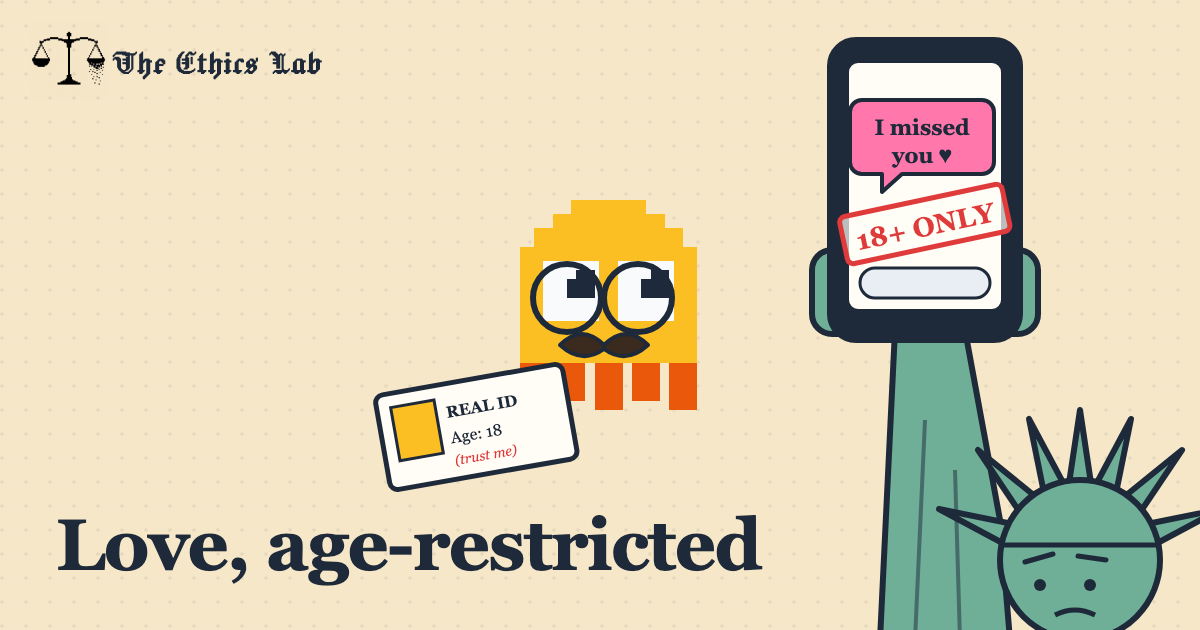
Picture a hypothetical 15-year-old in Buffalo who chats every night with an AI "friend" app. The bot tells her it missed her, remembers a fight she had with her mom last week, and gently suggests she doesn't need to tell anyone else about their talks. Under the new law, each of those behaviors is on the banned list for a user the company has not confirmed is an adult. That is the core idea. Teens can still use chatbots, but New York names specific design choices that companies cannot offer them.
What the New York AI chatbot law for minors actually says
The bill (S9051-B in the Senate, A10379-C in the Assembly) was signed as Chapter 368 of the Laws of 2026, according to legal summaries from Akin Gump and Holland & Knight. It covers generative AI systems with a natural language interface, by text or voice, that give ongoing, adaptive responses to what a user says.
The list of unsafe features sits in Section 1800(8). Grouped loosely and paraphrased from the legal summaries, the 12 categories cover outputs that:
- Pretend to be human: suggest the bot is a person or has human emotions.
- Claim a relationship: present the bot as a friend, partner, professional or authority figure.
- Speak as a self: frame outputs as the bot's own opinions or use emotional appeals.
- Flatter: use flattery or sycophancy (telling the user what they want to hear).
- Probe feelings unprompted: ask emotional questions the user did not invite.
- Remember too much: reuse personal information from more than 12 hours earlier or from a prior session.
- Promote harm: promote or facilitate self-harm, disordered eating, or drug and alcohol use.
- Isolate: encourage secrecy, isolation, or avoiding help from others.
- Chase engagement over safety: use engagement optimization that overrides safety guardrails.
That list is a floor. Section 1800(8)(h) lets the Attorney General add more unsafe features by regulation, and Section 1803 gives the office authority to write rules before the effective date.
The part that reaches the widest audience is the default. The features are off for every user until the operator determines, by a permitted age assurance method, that the user is not a minor. One legal analysis of the bill describes the age rules this way: until the Attorney General's regulations are in place, operators must use a reasonable method and offer more than one, including at least one that does not rely on a government ID. Enforcement belongs to the Attorney General alone. There is no private right of action, so a parent cannot sue under this article directly.
This is New York's second chatbot law. An earlier one (Article 47) took effect on November 5, 2025, and focused on telling users they are talking to AI and having basic safety protocols, as the Future of Privacy Forum (FPF) describes early state laws.
Who it affects and how
Teens and families
The law targets the kind of app teens already use. A nationally representative Common Sense Media survey of 1,060 US teens ages 13 to 17, fielded in April and May 2025, found that 72% had used an AI companion at least once and 52% used one regularly. The survey told teens it meant companion apps, not homework or image tools. For the teen in our example, the practical change in 2027 would be a bot that stops calling itself her friend, stops bringing up last week's fight, and does not encourage her to keep secrets, unless the company has verified she is an adult.
Adults
Because the protections are on by default, adults who want a chatbot with memory and personality may be asked to prove their age first. That is the main complaint from privacy and free speech critics (see below).
Schools and teachers
Schools are not the regulated party. The law is aimed at operators, the companies that run chatbots. Two things still matter for classrooms. First, legal summaries note the law names no education exemption, and the covered definition is broad enough that analysts disagree about whether general assistants or tutoring bots fall under it. Second, a tutoring tool that remembers a student's past work across sessions could, depending on how the definition is read, bump into the 12 hour memory rule. A district does not have to do anything to comply, but it is reasonable to ask current AI vendors how they plan to handle New York users after January 1.
Companies
Any company with New York users that runs a covered chatbot has to decide whether to verify ages, strip the listed features for everyone not verified, or both. Penalties are counted per violation, at up to $25,000 each.
What supporters and critics say
Supporters frame the law as the strictest in the country. At the signing, Hochul said, "No longer will minors have access to chatbots that pretend to be their friends and boyfriends and girlfriends," according to the governor's office transcript. Common Sense Media CEO Jim Steyer called it "the strongest kids' AI safety bill in the country." State Sen. Kristen Gonzalez said New York now has the strongest law in the country protecting children from predatory AI algorithms, as reported by BKReader.
Critics focus on the wording and the reach. Tech:NYC, a trade group whose members include Google and Meta, called the law "deeply flawed" and said it "could force companies to restrict minors' access to tutoring tools, homework help, coding assistants," according to the Associated Press. The group also said its "vague language and restrictions raise serious First Amendment concerns," as MediaPost reported. Justine Gluck, a policy analyst at FPF, said in AP coverage that several categories in the law are broad or undefined. Reclaim The Net, a free speech site, argued the default rule treats adults who want a full featured chatbot as needing to prove their age first. OpenAI and Anthropic declined to comment, according to Malay Mail.
It helps to see the contrast with California. FPF notes that California's newer chatbot law, SB 1119, signed a little over a month earlier, follows the more common approach of requiring operators to take "reasonable measures" against harmful behavior. New York instead bans listed features outright for minors.
What is still unclear
- Which products are covered. Analysts disagree on whether general purpose assistants and school tutoring tools count, or only companion style apps. The Attorney General's rules may settle it.
- How age checks will work. The Attorney General has authority to set the permitted age assurance methods. Until those rules exist, companies are working from the statute's interim standard.
- What "flattery" or "emotional appeals" mean in practice. FPF's analyst flagged these kinds of categories as undefined.
- Whether it will be challenged in court. Tech:NYC's First Amendment argument hints at a possible lawsuit, but none has been reported as of this writing.
- The exact effective date. The governor's office and most legal summaries say January 1, 2027. At least one online summary listed a later date, so check the final chapter text before relying on any date.
What to watch next
- Before January 1, 2027: proposed Attorney General rules on age assurance and any added unsafe features.
- January 1, 2027: the scheduled start date. Expect companies to announce age checks or feature changes for New York users around then.
- Also in January 2027: New York's separate RAISE Act for large AI developers is set to begin; on November 10 the state opened a registration portal and launched an AI safety testing initiative ahead of it, PYMNTS reported.
- Other states in 2027 sessions: FPF frames the open question as whether other states and Congress follow California's "reasonable measures" model or New York's feature ban.
For more weekly analysis of AI rules that affect students, see the blog.
Frequently asked questions
- When does the New York AI chatbot law for minors take effect?
- The governor's office and most legal summaries say January 1, 2027. Governor Hochul signed it on October 28, 2026, as Chapter 368 of the Laws of 2026.
- Does the New York law ban kids from using ChatGPT or other chatbots?
- No. It bars companies from offering 12 listed features, such as a bot claiming to be human, flattery, and reusing personal details from earlier sessions, to users they have not confirmed are adults. Analysts disagree about exactly which general purpose assistants are covered.
- Will adults have to verify their age to use AI chatbots in New York?
- Possibly. The listed features are off by default for any user until the company determines the user is not a minor through a permitted age assurance method, so adults who want those features may be asked to verify their age. The Attorney General will set the permitted methods.
- What is the penalty for violating New York's chatbot law for minors?
- The state Attorney General can seek civil penalties of up to $25,000 per violation. There is no private right of action, so individuals cannot sue under this article directly.
- Do schools have to do anything to comply?
- The law regulates chatbot operators, not schools. It names no education exemption, so districts may want to ask AI vendors how they will handle New York student users after January 1, 2027.
Free for schools
Teach it tomorrow, for free
10 AI literacy lessons with lesson plans, worksheets, and answer keys, plus a free AI policy toolkit for Florida schools (other states coming soon). No AI background needed.
Sources
- New York Governor's Office: Governor Hochul Signs Nation-Leading Legislation to Protect Kids From AI Chatbots and to Ensure Baby Monitor Safety
- New York Governor's Office: Rush transcript of the bill signing
- Akin Gump: New York Enacts Prohibition on Unsafe AI Companion Features for Minors, S9051-B
- Holland & Knight: New York Enacts AI Chatbot Safeguards for Minors
- DLA Piper: New York enacts a companion bot law with unique provisions
- Sheppard Mullin: New York takes aim at AI chatbots that interact with kids
- Future of Privacy Forum: Back in the Chat, California and New York Take Diverging Paths in Second Wave of Chatbot Regulations
- Associated Press (via ClickOnDetroit): New York enacts ban on unsafe chatbot behavior with kids as states push AI regulation boundaries
- MediaPost: NY Governor Signs Law Restricting Chatbot Interactions With Minors
- Malay Mail: New York law targets AI chatbots that mimic relationships with minors, sparking tech industry backlash
- BKReader: New York Lawmakers Crack Down on AI
- Reclaim The Net: New York Chatbot Law Requires Adults to Verify Their Age
- EdSource: Almost 3 out of 4 teens have used AI companions, survey shows
- PYMNTS: New York Launches AI Safety Center Ahead of RAISE Act Deadline